Thursday, April 18, 2024

 Moonstruck


The conference call included three men, a small but very powerful trio of advisers to EXPOTUS. Perhaps the conversation went something like this:


Epshteyn: Today’s court appearance did not go well, definitely not according to plan. Steve, you promised all hell would break loose. Hell stayed home.


Miller: What about fundraising? Did you put out the usual ‘asks’ by social media? All the usual platforms, especially those with video content?


Epshteyn: Of course. We didn’t miss a single outlet. I think our base is becoming jaded, bored, disinterested. The contributions just trickled in. Barely enough to cover legal fees.


Bannon: That’s disappointing. I thought sure EXPOTUS blasting the judge and violating the gag order would be a big hit.


Miller: We’ve tried everything to get the judge to react and throw EXPOTUS in jail, but he won’t take the bait. We’ve got to come up with new ideas. EXPOTUS in a prison jump suit would blow the roof off our fundraising.


Bannon: I think I have something. How ’bout this: at the next court appearance, what if EXPOTUS moons the judge?


Miller: Oh my God! You mean actually drop his pants?


Bannon: Exactly!


Epshteyn: Wow! That certainly ought to do it. Straight to the slammer, for sure. The contributions would pour in.


Miller: Wait a minute. I’ve played golf with EXPOTUS. I’ve seen him in the locker room fresh from the shower. It’s not a pretty sight.


Bannon: No problem. I have Hollywood connections. We’ll get the best makeup people in the business.


Epshteyn: Makeup? For his backside?


Bannon: Sure. You don’t think these movie stars do their nude scenes without makeup, do you? Moles, pimples, blemishes, unsightly hair—it all has to be covered up.


Miller: Geez, I had no idea. Do you think we should run it by our usual focus group? Maybe give ’em a demo?


Epshteyn: You could stand in for EXPOTUS, Steve. We’ll get you a blue suit, a red tie, a yellow hairpiece.


Bannon: No time for that. I say we go straight to the mattresses.


Epshteyn: So, do you think EXPOTUS will go for it?


Miller: Are you kidding? By the time I finish pitching it to him, he’ll swear it was his idea.


Bannon: All righty then. I’ll reach out to the makeup artists. Miller, you make the pitch to

EXPOTUS. Epshteyn, you tip the media that something big is going to happen.


Miller: Let’s go for it.


Epshteyn: Here’s to the next full moon.


All three: CHEERS!


And so it goes in the back rooms of power. Remember, all’s fair in love and politics.

_____


Friday, January 19, 2024


HISTORY ACCORDING TO THE VICTORS


The cable news networks have a camera station set up inside the capitol building in Washington D.C. Reporters stand in front of the cameras, microphones in hand, and report the latest happenings from the House and Senate. In the background stands a white marble statue of Jacques Marquette, a Jesuit priest, who in 1673, accompanied by Louis Jolliet, laid eyes upon the mighty Mississippi. The engraving on the base of the statue reads:


WISCONSIN’S TRIBUTE

_____

JAMES MARQUETTE   S.J.,

WHO, WITH LOUIS JOLIET

DISCOVERED THE MISSISSIPPI RIVER

AT PRAIRIE DU CHEIN, WIS.

JUNE 17, 1673


Imagine the dialogue at that historic moment. Maybe it went something like this:


Marquette: Oh joy, oh rapture! Jolliet, look at this magnificent river. Such power, such potential!

Jolliet: Praise be to God, the creator!

Marquette: [Speaking to his guide and interpreter, a Sioux known as Many Tongues LeBeau] LeBeau, ask our native friends if they are familiar with this mighty stream.

LeBeau: [Speaking to Proud Eagle, a chief of the Menomonee tribe] Chief, the white devil wants to know if you are ‘familiar’ with the river.

Eagle: Is this white mans' humor? Are we ‘familiar’? Our people have lived on this river since time began. Tell him we were here while his ancestors lived in caves and ran from the giant lizards.

LeBeau: [To Marquette] He says he’s never before seen these waters.

Marquette: But how can that be?

LeBeau: There is a legend of a great flood where only a handful of beasts survived. Native people stay far away, on the other side of yonder ridge.

Marquette: Did you hear that, Jolliet? We are the first to stand on this ground.

Jolliet: Praise the Lord!

Marquette: Ask him how far—in legend—the river extends.

LeBeau: He wants to know how far the river runs.

Eagle: It begins upstream at a lake we call Itaska and extends far down river to where it empties into a vast open sea. By canoe, a brave would take a hundred suns to reach the sea.

LeBeau: [to Marquette] He says he has no idea.

Marquette: It appears to be navigable. Think of the commerce, think of the trade, think of great cities rising on its banks! Ask him if legend has given this mighty torrent a name.

LeBeau: What do you folks call the river?

Eagle: We call it Misi-ziibi. It means Big River.

LeBeau: Big River? That’s the best you’ve got?

Eagle: It sounds better when you say Misi-ziibi.

LeBeau: The chief says it is called Misi-ziibi, which means ‘Mother of all waters, flowing swiftly to the heavenly sea’.

Marquette: Oh rapture! Oh joy! Jolliet, we have discovered the Mississippi. I will call it ‘River of the Immaculate Conception’.

Jolliet: Halleluiah!

Eagle: These people are crazy. Why are they so worked up?

LeBeau: They think they discovered the river.

Eagle: Sheesh… Tell him there were other white devils, way down river, who were here in the time of my great great grandfather.

LeBeau: Father Marquette, the chief congratulates you and your friend, Monsieur Jolliet, on this grand discovery.


So it is written. So let it be carved in stone. Back to Wolf Blitzer in the studio…

_____


Sunday, January 7, 2024

Lone Rat


It was a quiet January morning and Homer Bumwell was hard at work in his palatial office. His massive desk held four large flat-screen monitors, one tuned to CNN, the other three focused on company business. As President and COO of YahYouBetcha, the fastest growing online gambling operation in the U.S., he took great pleasure in keeping track of the betting action on the company’s many platforms. With the NCAA championship game on the horizon and the Super Bowl just a few weeks away, the gamblers were out in force. Thank God for cloud computing and infinite capacity, he thought. Go ahead, suckers, bet to your hearts’ content.

The monitor tuned to CNN was on the far-right side of the desk, the sound muted, the banner at the base of the screen scrolling news that included the words “active shooter” and “Iowa.” Bumwell paid no attention.

There was a polite knock on his door and Bettsy Lovelady, his secretary, popped her head in. “Good morning, Mr. Bumwell. Mr. Zipper is here to see you.”

Homer checked his Rolex. “Great, right on time. Send him in.”

The door opened wide and Hardy Zipper, Vice President of Business Development, walked briskly into the office, his right hand extended to shake hands with the boss. “Mr. Bumwell, thanks for seeing me on short notice. How are you, sir?”

“Never better, Hardy, never better.” They shook hands firmly. “Let’s use my conference table so these damn monitors won’t be in the way.” They walked to the large mahogany table surrounded by comfortable leather chairs. The floor-to-ceiling windows looked out on a placid lake where the occasional trout broke the surface to slurp up an insect. Bumwell sat at the head of the table while Zipper took a chair to his right. “Now, what’s on your mind, Hardy? Why did you insist on meeting first thing this morning?”

“I have an idea to run by you, sir. I think you’re gonna love it. It has great growth potential and, quite frankly, it’s based on a gift that just keeps giving.”

“Hmm…well you certainly have my attention, Hardy. Let’s hear it.”

“Okay, so you know how our volume drops off after the Super Bowl. Football fans are the best there is and they can’t get enough action. But after the Super Bowl, things get quiet. Our revenue takes a dive. March Madness is a nice bump, and the NBA is pretty solid, but nothing makes up for the football action. And we all know baseball is a dud. Very few gamblers want to bet on baseball.”

“Okay, I’m with you so far.”

“My idea could fill the gap between football seasons and I think you are going to agree it has significant growth potential.”

“I’m listening.” Bumwell glanced at his watch. Get to the damn point, Hardy. I don’t have all day.

“Okay, here it is. We build a site to bet on the next mass shooting.”

“What? You’ve got to be kidding me!”

“I kid you not, sir. We could lay out a sweet menu of betting options for our clients. Like, how many days until the next ‘active shooter’ event.”

“I don’t know, Hardy, they happen so often now.”

“Or covering the spread on how many victims.”

“Hmm…that’s interesting.” Homer drummed his fingers on the conference table.

“How ’bout the shooter’s weapon of choice?”

“Nah, ninety percent of ’em use that frickin’ AR-15.”

“But we could give long odds on something other than an AR-15. And how ’bout this—the venue. Is it a school, a church, a synagogue, a shopping mall, a dance hall? Think of the possibilities, sir. The list is endless.”

“I’m startin’ to feel you, Hardy. How about the shooter’s choice of social media? Did he post his manifesto on FaceBook, Instagram, Truth Social, or whatever—”

“And don’t forget the potential parlays, like ‘I’ll take more than ten victims, at a school, and YouTube for social media.’”

“By God, Hardy, I think you’ve got something.”

“Our tech crew could put up a site in no time, including an app for the iPhone junkies.” Hardy was grinning ear-to-ear.

“You got that right. But what can we call it? How ’bout ‘Lone Wolf’. These whack jobs typically act alone.”

“Sir, that’s an insult to wolves. I’m thinking we call it ‘Lone Rat’. How does that grab you?”

“I love it! ‘Lone Rat’ it is. Okay, okay…let’s slow down a little. We want to do this right. Let’s call a meeting of the management team to brainstorm ideas. Then we can meet with the statisticians and odds-makers to make sure they can handicap this shit. After that, we’ll call in the tech geeks and get the ball rolling. Oh, and in the meantime, I’d better run it by legal. We need to make sure any exposure won’t break the bank.” Homer leaned back in his chair, smiling. “Hardy Zipper…”

“Yes, sir?”

“You are one hell of a guy! No wonder I pay you the big bucks. The ball’s in your court, Zip. Now get the hell out of here and get to work.” Zipper was halfway to the door when Bumwell jumped to his feet. “Wait a minute! Here’s another one: they could bet the over-under on how many senators and congressmen will offer thoughts and prayers.”

“Brilliant, Chief! I’ll add it to the list.” Zipper closed the door behind him.

Bumwell returned to his desk. On the monitor tuned to CNN, the Sheriff of Dallas County Iowa stood in front of a bank of microphones, about to convene a press briefing in a town called Perry.

_____


Wednesday, December 20, 2023

 Author's note: The review that follows was posted in January 2020. I'm reposting it here in memory of Charlene Imhoff Dividson who passed away December 18, 2023. That's her in the picture below, second from the right--beautiful, talented, and a dear, sweet friend. Rest in peace, Sis.


Remember When…

By C.W. Spooner

“Sly walks in and says, ‘Does anybody sing harmony or are y’all going to sing melody?’”

-          Charlene Imhoff Davidson

That was the In the Beginning moment for a doo-wop group that came to be known as the Viscaynes, six kids from Vallejo, California. “Sly” was Sylvester Stewart, known in his community as a musical prodigy. Guitar, keyboards, horns—was there an instrument he could not play? And there was the voice that could hit the sweet high notes when they were needed.

Frank Arellano and Charlene Imhoff had a group and showed up for talent contests. That’s where they first heard Sly, a classmate, Vallejo High Class of ’61. Frank asked for help to “get our harmonies together,” and Sly said “sure.” The group grew to six members, including Charlie and Verne Gebhardt and Maria “Ria” Boldway. They began to meet in the Gebhardts' rec room, equipped with a piano and encouragement from Charlie and Verne’s parents. Along the way, Mike Stevens joined to play piano. They’d stay in that room for hours.

All that practice paid off and they began to win talent competitions. In the spring of 1961, they auditioned for the Dick Stewart Dance Party, the San Francisco equivalent of Dick Clark’s American Bandstand. They were accepted. The television appearance and talent show wins led to recording sessions in San Francisco where they cut a series of 45-RPM sides, including “Yellow Moon.” That tune became a hit in the Bay Area, reaching number 16 on radio station KYA’s Top 60 chart.

This backstory is meant to call your attention to a reissue of those venerable tracks recorded in 1961. It is titled The Viscaynes & Friends, and it’s available on MP3, CD or vinyl. Amazon delivered my CD a few days ago and I’ve been spinning it ever since. Songs like "You've Forgotten Me," "A Long Time Alone," and "Heavenly Angel" take me back to a simpler, brighter time when absolutely everything was possible. My only complaint is that two of my favorites are missing: “Stop What You’re Doing,” and “I Guess I’ll Be,” both featuring Charlene’s clarion voice. You’ll have to go to YouTube to hear those two.

As we know, Sly went on to fame and fortune as the star of Sly and the Family Stone. But fame and fortune cuts both ways, especially in the music business. Sly has seen some very hard times, but the latest word is that things are a little better. Will there be a happy ending? Let’s hope so.

None of that dims the legacy of the recordings that will live forever with the release of The Viscaynes & Friends. There is a quotation in the liner notes that captures the pure joy of the ride home from a recording session. It could be attributed to any member of the group, because their collective memory is as tightly woven as their harmony:

“We did not come home until five o’clock, six o’clock in the morning, because we recorded all night. Coming home, it was the coolest image ever. I close my eyes and I can see it, all seven of us, in Mike Stevens’s dad’s convertible. We are coming across the Bay Bridge, and the sun is coming up, with the top down, singing to the top of our lungs. It was the coolest thing ever.”

I highly recommend this album. Put it on, close your eyes, feel the wind in your hair, and watch the sunrise over the East Bay hills.

_____

PS: This release of the "Complete Recordings 1961 - 1962" came out later and included Charlene singing lead on "Stop What You're Doing" and "I Guess I'll Be." 


_____


Sunday, August 20, 2023

FISH ON!

A real fish story


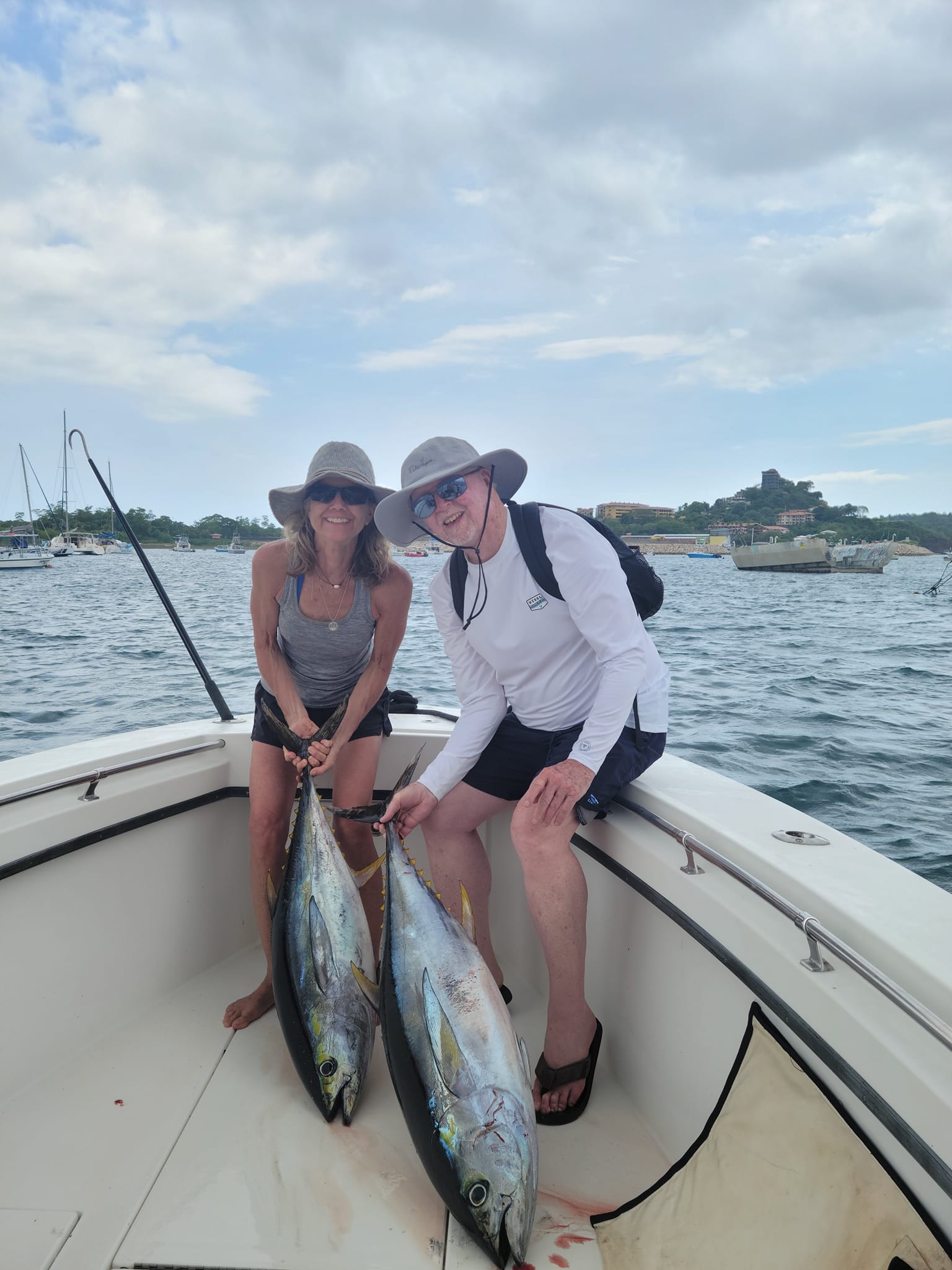
Look!” Frank shouts. “Straight ahead, where the birds are!” Frank, our fishing boat captain, shoves the throttle to full ahead and we race toward what boat captains call la mancha—the stain—an area the size of a small arena where the deep blue ocean has been churned to a white froth. “Oh man, there are some big tuna breaking water, feeding on the surface.”

I can’t see the tuna but I definitely see the birds circling the area and diving into the water. And then the most amazing sight of all: spinner dolphins flying into the air, turning a half-dozen rotations before falling back to the water. Until this day, I’d never heard of a spinner dolphin, let alone seen one. And yet there they are—one, two, three, and more—shooting into the air like prima ballerinas.

We are twenty-five miles off the west coast of Costa Rica, out of the harbor town of Flamingo. Our party consists of my daughter Cheryl and her husband Bruce, their sons Mason and Collin, my daughter Kim, and me. Cheryl and her family have lived in Tamarindo for more than twenty years and are involved in several business ventures there. Kim lives in Welches, Oregon, with her husband Cliff and extended family. It’s my first visit to Costa Rica, a gift from my five children in honor of my eightieth birthday, and this will be a day I’ll never forget.

Bruce and my grandson Collin are experienced spear fishermen. Captain Frank will try to position the boat out in front of the dolphins and tuna. Then Bruce and Collin will jump into the water with snorkel gear and spear guns and descend about thirty feet below the surface. The dolphins will come racing by, followed closely by a school of yellowfin tuna. The goal is to get a good clean shot at a tuna, after which the speared fish will dive deep, taking with it a line attached to a float. The fish will eventually wear itself out, the float will come to the surface, and the catch hauled in.

We speed along with forty, fifty, a hundred or more dolphins racing alongside the boat. Bruce and Collin are in the bow, ready to go into the water. My grandson Mason is busy capturing as much of the action as possible via his 35 mm camera and his trusty smartphone. He is a skilled photographer, filmmaker and editor, like a young Spielberg. In the meantime, Captain Frank’s deckhand has rigged two fishing poles and cast them to troll behind the boat. Finally, Frank cuts the engine and Bruce and Collin are in the water, dropping below the surface, hoping for a clear shot as the tuna race by.

“Fish on!” Frank shouts. The rod nearest me bends at a ninety-degree angle and the reel sings as the line races out. “Grab that rod, Chuck. Let it run if it’s taking line, otherwise crank hard, reel it in.”

I go to the rod and begin reeling. The fish makes a couple of runs and I keep on cranking. My arm is tiring and I think about giving up, handing the job to someone else. But call it pride or call it machismo, there is no way I can quit. I keep straining to gain line. Suddenly the fish comes into view. I’m winning the battle. Now the deckhand moves in, a heavy glove on his left hand, a long gaff in his right. He grabs the line with his left hand and pulls the fish near the side of the boat. With his right, he makes a quick move with the gaff and jerks the fish up into the boat. It flaps wildly on the deck, blood splattering everywhere. In a matter of minutes, the deckhand has the yellowfin safely in cold storage, surrounded by bags of ice. Our best guess is it weighs about sixty pounds.

Bruce and Collin swim back to the boat disappointed. The drop point must be precise to find the tuna schooling behind the dolphins, and this time the positioning was off. Captain Frank idles as the spearfishermen climb aboard. All the while, the great gathering of fish and sea birds has moved on. The captain guns the engine and off we go, his eyes alternating between his radar screen and the horizon.

            Finding la mancha is a continuing challenge because the fish change direction frequently. We spend most of the day dashing here and there, trying to relocate our prey, successful on at least two more occasions. Late in the day the shout of “fish on” goes up again. This time Cheryl takes the rod and begins reeling. Aided by Collin, she lands our second yellowfin of the day. It’s a little smaller than the first one, but a beauty, nonetheless. Bruce and Collin come up empty, unable to find their prey today, but we have two nice tuna to bring home. 

It’s time to head back to shore and we begin the long journey home. I think about Cheryl and Bruce and the life they’ve built here in Costa Rica. Their entrepreneurial ventures are too numerous to list here, but the current flagship is their property management firm: Stay in Tamarindo. If you have an urge to visit Costa Rica, maybe catch a tuna of your own, or visit a volcanic national park, or catch a perfect wave on your surfboard, Stay in Tamarindo has the ideal vacation rental for you.

            The boat races on, the harbor coming into view. I think about Kim and the beautiful life she and hubby Cliff have built in Welches, Oregon. Kim provided a last-minute surprise, joining me in Los Angeles for the flight to Costa Rica. She will be with us for the first week of my stay and it is a joy to have Kim and Cheryl in one place at the same time. It doesn’t happen often enough. From these two beautiful daughters, I count seven of my twelve grandchildren, plus five great grandchildren, soon to be six.  

            What did I ever do to be so blessed?

***

Back home, Bruce goes to work immediately to clean and filet the fish. Collin and Mason jump in to make it a team effort. As Bruce carves off the filets, Collin trims and cuts them into thick steaks while Mason packs and seals them in freezer bags. Cheryl and Kim join the team, preparing rice, green salad, and other side dishes. My job is to hoist a cold beer and offer encouragement. Later that evening, we sit down to a dinner featuring perfectly seasoned and seared tuna steaks. It isn’t lost on me that these delicious steaks were swimming freely in the deep blue Pacific earlier this same day.

Through all of this teamwork, Mason has been telling us about a documentary series narrated by Sir David Attenborough titled Our Planet. One episode, “The High Seas,” features a segment on spinner dolphins. After dinner, we gather in front of the TV and Mason finds the episode we’re looking for. It is a fascinating explanation of what we witnessed at sea.

It turns out dolphins and yellowfin tuna feed on the same tiny species called lantern fish, a species that thrives because it has no commercial value and is, therefore, not hunted by the fishing fleets of the world. Yellowfin tuna follow the dolphins because dolphins are like cowboys, herding the lantern fish together into a compact school. The Attenborough team’s brilliant underwater photography captures this phenomenon perfectly, the dolphins working to keep the school together, the school of lantern fish looking like a giant balloon, swerving and swirling, held tight by the hard-working cowboys, all the while pushing the school toward the surface. Then, as though someone fired a starter’s pistol, the feast is on. Dolphins and tuna attack the lantern fish in a feeding frenzy, joined by sea birds diving from the air, creating the boil on the surface of the ocean the fishing captains call la mancha.

As for the spinner dolphins, according to Attenborough, they are very rare, found primarily in two locations: off the coast of Costa Rica and around the Hawaiian Islands. I am stunned! On a planet seventy percent covered by water, I spent the day in one of the two places on Earth that spinner dolphins call home.

When Sir David says goodnight, so does our intrepid crew. We’ve been up since four in the morning, a very long day indeed. Still, it takes a while for my mind to calm down and prepare for sleep. Every time I close my eyes, one, two, three, or more spinners go flying into the air, and Captain Frank is shouting, “Fish on!”


                                                  Me, Cheryl, Collin, Mason, Bruce, and Kim

_____


Thursday, May 11, 2023

 Author's note: My friend, Dillon Mini, would have turned 82 on May 17. Growing up together, we were truly like brothers. 

Remembering Dillon

from Yeah, What Else?


The facts are straight forward: “Dillon James Mini, 73, passed away on Monday (September 15, 2014) after a long illness.” The obituary doesn’t contain a lot of detail, but it doesn’t need to. Not for me. For me, the details are all in my mind, like a shoebox full of old snapshots that you have promised to organize—someday. I am going to open that shoebox now and let them come tumbling out.

Here’s one of Dillon and me walking down the Jennings Street hill, heading who-knows-where, maybe to my house down on Russell Street, or down to the playground at Steffan Manor. It’s summer and Dillon just turned eight, and I’m six, looking forward to my seventh birthday in September. This was the day we swore to each other (probably a pinky swear) that we’d be best friends forever. We kept that vow for a long, long time.

Here’s a picture of his dear parents, Dillon H. and Bernice. I remember the first time I knocked on their front door to ask if Dillon could come out to play. My orthodontist had fitted me with an elaborate headgear contraption that looked like a canvas helmet; it had a metal chin cup attached with rubber bands, and it was designed to pull my jaw back and correct a severe under-bite. Mrs. Mini answered the door and I think she was shocked to see me there, looking like a little alien. Over time, the Minis became second parents to me, and what beautiful people they were. Mrs. Mini was one of the all-time great cooks, at least in my book, and she loved feeding me. And Mr. Mini was always playful and funny, teasing me gently, making me laugh. I’m not sure why, but they liked me and treated me like a son, taking me along wherever they traveled.

Here is a good one. It’s a picture of Bruce Bigelow with Dillon and me on the day Bruce moved into the neighborhood. Dillon and I saw him playing in the yard there on the corner of Buss and Russell, and we went over and introduced ourselves. Bruce was about eight at the time. It was the start of a three-way partnership that would last most of our lifetimes.

This next one is priceless. It is from the sports page of the Times-Herald and it’s our City Championship baseball team – Underweight Division. There’s Dillon with the catchers gear falling off his body, always too big for him; and Bruce, Jerry Warren, Andy Carlson, John O’Neil, Mike Kennedy, and of course, Jake Catado, our GVRD playground leader at Steffan. What a great guy! Jake, if you’re reading this, you should know that we all loved you.

God, what fun that was: hanging out down at Steffan, going out to the ball field to practice, traveling across town to play other schools. We’d pile into Jake’s old Chevy, a dozen of us or more, and sing “99 Bottles of Beer on the Wall,” or “John Jacob Jingleheimer Schmidt” all the way across town. It was pure fun. No pressure, no expectations, just the love of the game and each other.

Here is a great shot: Dillon, Bruce, and me on Little League opening day, 1952; Dill and Bruce wearing their Steffen’s Sport Shop uniforms and me with Ed Case’s Minit Men across my chest. It was the first Little League in Vallejo and we were part of a group of sixty kids that got it started. It was an experience none of us—Dillon, Bruce, Jerry, Roger Ashlock, Frank Bodie, Eddie Hewitt, Joey Butler, Tom Case, Al Manfredi, Jim Eaton—I could go on and on—will ever forget. In fact, we still rehash the old play-by-plays when we get together.

This next picture makes me smile. There we are on somebody’s lawn, surrounding a big, handsome collie named King. King belonged to Gary and Lennie Price and he had some sort of tumor that had to be removed. So, we went out mowing lawns to raise money for the vet. Someone called the Times-Herald and we wound up on the front page. Several readers offered to pay for King’s surgery, so we didn’t have to mow many lawns. Was the lawn mowing Dillon’s idea? Or was it Roger’s?

Later that summer, we all took a hike out to Blue Rock Springs, then up over the hills to the old, abandoned mercury mines to go exploring. Gary fell down a mine shaft. He was lucky to survive. We never went hiking out there again.

This next one is a classic: Dillon in his football uniform at Hogan Junior High. Yeah, football. You see, Dillon was always small for his age. As an adult, he was maybe 5’6”, 120 pounds. But in the ninth grade, he still had some growing to do. All of his young life, people would tell him “…you’re too small to do that.” Whether it was baseball, football, bowling—it didn’t matter. So naturally he set out to prove them all wrong.

I remember going out to watch the team practice on the Hogan field. Bill McGrath was a tenth grader, the star of the team, and he was built like a tank. Coach Pelligrini was running a drill where there were two lines about ten yards apart: ball carriers and tacklers. When you came to the front of the line, he’d toss the ball to the ball carrier who would take off running. The tackler’s job was to bring him down. They had to stay in a narrow lane marked by two blocking dummies. It was bound to happen sooner or later, and sure enough, Bill and Dillon wound up facing each other, Bill the ball carrier, Dillon the tackler. They went at each other and Dillon hit Bill hard, just above the kneecaps. Of course, he just bounced off and Bill ran on through, but everybody who witnessed it came away with great respect for Dillon Mini. He had more guts than anyone out there.

Here’s a picture of Dillon as student body president at Hogan in the tenth grade. He wrote a column for the school newspaper titled “Pres Sez.” If you had asked me then (1957), I would have predicted that Dill would have a career in politics. Prominent family name. Good looking guy. Intelligent. Great personality. He was a natural.

Here’s another good one. It’s our bowling team down at Miracle Bowl on Tennessee Street. We were all in high school at the time. Miracle Bowl sponsored us and the idea was that we’d travel around and bowl junior teams from other towns. There’s Dillon, Bruce, me, and Buddy Whisenhunt. Buddy was a lefty and a terrific bowler. Bruce and I were just okay. The traveling team idea never jelled, but we had fun while it lasted. Dillon would go on to become one of the best bowlers in Vallejo. He had several three-game series in the 800s and his press clippings could fill a scrapbook.

Oh my, here’s a stack of photos from Tahoe. In the early fifties, the Minis bought a cabin near the South Tahoe Y. They would always spend the last two weeks before Labor Day at the cabin, and they’d invite me to join them. I treasure the memory of those summer days. Here we are trout fishing on the Upper Truckee River; playing miniature golf down by Bijou; exploring the woods behind the cabin; playing hours and hours of ping pong in the garage; and hanging out on the beach at Camp Richardson. And here are the Silveiras who eventually built a place up there: Manuel & Mildred, plus Marie, Mike, and Marty. What a great family, and what a dear friend Marie was. And here are Mr. and Mrs. Bradley with Jerry and Russ. We had a lot of fun with the Bradley boys.

One time Jerry Bradley Sr. checked us all into the movie theater at Harrah’s. We were supposed to stay there until an adult checked us out. The movie stunk so we snuck out and hit the streets of Stateline—me, Dillon, Jerry, and Russ. (I think Marie was babysitting for Mike and Marty.) It was all cool until one of us decided to drop a quarter in a slot machine just inside the door of Harrah’s. We got busted and they paged Mr. Bradley to tell him his kids were loose on the street. With firm conviction he said, “They are not! I put ‘em in the movie myself.” We caught a lot of flak over that one.

There are about a thousand pictures from Tahoe in my memory bank. We’ll have to look at all of them someday.

This next shot is a beauty. It is a picture of Dillon as a member of a wedding party. He looks great in the white dinner jacket and the black tux pants. What a handsome guy! Our friend Charlie Gebhardt sang at that wedding. I remember he muffed the first verse of “The Lord’s Prayer” and had to start over. Dillon cracked up laughing. Charlie made it through on the second try without a hitch.

Here is a picture of Dillon putting out a For Sale sign in front of my mom’s house in 1975. We had to move her into an assisted living facility and Dillon handled the sale. He was in the real estate business for a number of years, though I couldn’t tell you exactly how many.

This next one hurts. It’s a picture of Dill and me sitting on a couple of bar stools down at Teeters, a joint near Georgia Street and the freeway. The place eventually changed names but we kept our same old stools. Whenever I would drive through Vallejo, usually on the way to The City, I’d stop at Teeters to see Dillon. Nine times out of ten he was there. We would throw back a few tall cold ones and rehash all the good old times.

How stupid of me! Why didn’t I jerk him off that stool and drag him out of there? Would it have made a difference? Would it have changed anything in the later part of his life? I guess I’ll never know. As my sons would say, “That’s on you, Dad. You’ll have to wear that one.”

The next picture is bitter-sweet. A bunch of us got together to visit Dillon in the group home where he spent his days before he moved into hospice care. I think it was 2011. There we are: Jerry Warren, Roger Ashlock, Russ Sturgeon, Gordie Maki, Sargent Johnson, Dave Plump, and me. We took him to the Sardine Can for lunch. I think he really enjoyed getting out with the guys. He was able to walk, slowly, with a walker, and he smiled and laughed and conversed with all of us, at least a little. I hope it was a good day for him.

Here are a few pictures I’d like to erase. On my last visits with him, he was barely able to walk, and our conversations consisted of his one-word responses to my questions. It was just a matter of time.

Ah, now this last picture is real. It’s not just in my mind. It shows Dillon bowling, at the foul line delivering the ball, rolling what I’m sure was a sledgehammer shot to the 1-3 pocket. Yes, I know the photo is old and battered, but I want you to see it through my eyes. Look at the form. Look at the concentration. You can almost feel the fire in his belly. He was some competitor, my friend Dillon. And there he is at the very top of his game.

This is the way I will remember him. He was beautiful. Wasn’t he?


_____


Friday, April 7, 2023


The Rites of Spring

 from Yeah, What Else?


 I got the best shit in town. Nobody’s got shit like I got shit. I tell you, it’s the best shit in town.”

He was a wiry little man with a thick salt-and-pepper moustache and he wore bib overalls and a railroad cap. He spoke with a heavy accent, which my mom identified as German. His dump truck looked like it was built by hand on a very old Ford chassis. The mechanism that lifted the bed was a jerry-rigged cog and chain contraption that he cranked by hand, and the sides of the bed were made of two-by-fours and plywood. Onto this strange looking rig, he could load ten yards of steer manure, which he delivered to our house on Russell Street every spring.

The delivery generally took place on a weekday when my dad was at work, so my mom took care of having the load dumped in our driveway and paying the man for his goods. Mom loved to tell the story and I always thought she was exaggerating. That is until I witnessed it several times when I was home on spring break. That gentleman really could go on a five-minute rant about “…the best shit in town.”

My dad’s vegetable garden was his pride and joy. He was an Arkansas farm boy and I suspect that gardening put him in touch with his roots. We had a narrow strip of grass that ran along the back of the house, ten feet wide at the most, then the rest of the yard—maybe fifty by sixty feet—was given over to vegetables. Dad raised several varieties of lettuce, squash, and beans. There were root crops like carrots, radishes, and turnips. He also raised Swiss chard which was one of my favorites. But without question, he poured the greatest measure of his love and labor into his prized sweet corn.

Dad favored a hybrid variety of corn called Golden Bantam. Over the years, he experimented with others, but always came back to that one variety. He would plant a couple of long rows, let it get well up out of the ground—maybe six or eight inches—then plant another couple of rows, and so on. The happy outcome was that we’d have sweet corn ripening and ready for the table all summer long. It was the staple of our summer diet: whatever else was going on the table, it would land there next to the sweet corn.

I have to admit this turned me into a sweet corn snob. My dad taught me that when corn is picked, the sugar in the kernels begins to convert into starch. If it sits around for a while, that wonderful sweetness is lost, and all the butter and salt in the world will not make up for it. I rarely buy corn at the supermarket because I know it just won’t measure up.

So, the wiry little German man would deliver ten yards of steer manure to our driveway and that weekend, my dad would begin the process of carting it back to his garden plot, one wheelbarrow load at a time. He’d spread it out over the fallow ground and then begin digging it into the soil by hand, a process that would take most of a Saturday or Sunday afternoon. He’d stop every now and then for a cold beer, or to scoop up one of our cats and scratch its ears, but he’d always finish the job by sundown. A shovel was the only tool he needed. Dad was past his sixtieth birthday when we finally convinced him to hire someone with a rototiller to do the job.

Why am I telling you all this? Well, it’s almost time to head over to my favorite garden supply store and load the trunk of my Honda with eight or ten bags of steer manure. This I will spread on my four-by-twelve-foot tomato patch and then dig it into the soil with my trusty shovel. It doesn’t take more than an hour or so, but I’ll manage to stop for a couple of beers. And my beloved cat, Sophie, will be hanging around, keeping an eye on the proceedings. Maybe this is all a guy really needs: a piece of God’s good earth, a sturdy shovel, a loyal cat, and a couple of beers chilling in the fridge.

I’ve had good production from several varieties—Early Girl, Better Boy, Sweet 100, to name a few—but my all-time champ is the Lemon Boy, a nice big yellow tomato. Good old Lemon Boy just seems to love my little piece of ground.

Here’s a little bit of irony: for all my dad’s expertise and hard work, he could never grow a decent tomato. Maybe he just overwhelmed them with care. They always seemed to turn out with thick white cores and they were virtually tasteless. One summer, our neighbors, the MacLaughlins, drove to Oklahoma to visit family. They planted some tomatoes before they left and told my dad that if he watered them, he was welcome to whatever fruit developed. These poor neglected plants—unstaked, untended, unloved—produced the biggest and best tasting tomatoes ever grown in Vallejo.

My dad swore he’d never plant another vine, which leads me to wonder if he would have admired my tomatoes as much as I admired his corn. It’s something to ponder.

At any rate, in a week or so I’ll make my annual trek to the garden shop and load the trunk with bags of steer manure. I can’t say it’s the best shit in town, but my Lemon Boy sure seems to like it.

_____


                                                         Charles Sr., my dad, c. 1940
               _____