Tuesday, May 7, 2024

 The Power of Words


I just finished reading Doris Kearns Goodwin’s An Unfinished Love Story – A personal history of the 1960s. This is a must-read for history lovers, especially if you came of age in the decade of the 60s. It will take you through all the milestones etched in your memory: the first televised presidential debates; Kennedy’s inaugural address; the Cuban Missile Crisis; and on and on. There are triumphs, such as the Civil Rights Act (1964), Voting Rights Act (1965), and Neil Armstrong setting foot on the moon in 1969. And there are tragedies: the assassinations of JFK, MLK, and RFK; riots in many of our great cities; and of course, the Vietnam War and the debacle of the 1968 Democratic National Convention in Chicago.

Richard “Dick” Goodwin was in his twenties when he joined the Kennedy campaign in 1960 as an assistant to chief speech writer Ted Sorenson. During a remarkable career in public life, Dick Goodwin worked for John Kennedy, Lyndon Johnson, Eugene McCarthy, and Robert Kennedy. His fingerprints and his words are found in major speeches and policy declarations for all these men. Pick a major policy initiative of the 60s and Dick Goodwin was there.

I first became aware of Doris Kearns Goodwin in 1994 when she appeared in Ken Burns’s documentary, Baseball. She recalled listening to Brooklyn Dodger games on the radio and keeping score to give her father a play-by-play account when he arrived home from work. She was six years old and convinced she was keeping her father’s love of the Dodgers alive. I’ve been a fan of DKG ever since hearing that story. In addition to being a baseball fan, she has compiled a distinguished career as a presidential historian. Her books include: Lyndon Johnson and the American Dream; Team of Rivals – the Political Genius of Abraham Lincoln; Leadership in Turbulent Times.   

Dick Goodwin met Doris Kearns in 1972; they married and were together until his death in 2018 at the age of eighty-six. This book was their last collaborative effort, a sequential review of more than three hundred boxes of archival material Dick had accumulated over his years in public life. The fact that he died before the book was completed suggests the title: An Unfinished Love Story. That Doris went on to complete the project gives their story its exclamation point.

Beautifully written. Packed with emotion. Highly recommended. As I said in the beginning, this is a must-read, especially if you are of a certain age.


_____


Friday, May 3, 2024

 Sunday, May 5, 1968

from '68 - A Novel


John Harris stood on the sidewalk on the north side of N Street, taking in the well-maintained vista of Capitol Park in Sacramento. He took Martha’s hand as they started down the broad walkway that led past the east entrance to the Capitol Building. They came to a spot near an ancient magnolia tree and John came to a halt. Across the grass and through the trees, he could see the landscaped grotto that housed the monument.

            "There it is, Martha." John gestured toward the structure in the grotto.

            “I see it, honey. Are you going to be okay?”

“Yeah. Just give me a few minutes.”

He was there at his doctor’s suggestion to confront his demons, to see if they could be beaten back, or at least controlled. If he could do this, then maybe the nightmares would subside. Maybe he could even sleep through the night. He continued north along the walk and turned right onto a paved path named for former governor Hiram Johnson. And then he was standing in front of the monument to the USS California.

The California was John’s ship. He’d joined the crew in January of 1944 when she sailed from Bremerton, Washington. The Puget Sound Navy Yard had repaired the damage sustained at Pearl Harbor on December 7, 1941, and the California would go on to fight in battles all across the Pacific, exacting a heavy measure of revenge against the Japanese. Her great 14-inch guns became an important part of the battery that would be arrayed to pound each successive island before the Marines went ashore, firing shells the weight of a small car against the shoreline defenses.

Then came the day, the battle of Lingayen Gulf, when a kamikaze came screaming out of the clouds, leveled off and roared into the California’s superstructure. That was January 6, 1945. Forty-four men died that day; more than one hundred and fifty were wounded. Emergency repairs were made on the spot; ship and crew fought on. More than two weeks later, when the job was done, the California steamed back to Puget Sound for permanent repairs. John was reassigned and he finished the war out of harm’s way. But the California returned to service in the Pacific, first at Okinawa and, finally, supporting occupation forces in Japan.

For John Harris, it was only the beginning. He would relive January 6, 1945, over and over in his dreams. He would see himself frantically feeding ammunition to the anti-aircraft gun, see the kamikaze glide into a level path headed for the ship, see the gunner firing desperately at the plane, and watch helplessly as it sailed overhead to explode against the ship. In his dream, he could feel the heat from the fireball, and he could hear his shipmates scream in agony amid the flames.

Now he was standing in front of the monument. It was a simple structure: two square stone columns supporting a stone cap across the top with the inscription: U.S.S. CALIFORNIA. From the crosspiece hung the ship’s bell, its clapper removed. The California was decommissioned in 1947 and sold for scrap in 1959. This bell was all that remained of a once mighty warship. The carved legend on the left column read:

ONLY BATTLESHIP BUILT ON THE PACIFIC COAST

LAUNCHED AT MARE ISLAND NAVY YARD NOV. 20, 1919

SHIPS BELL DEDICATED AND RUNG FOR THE LAST TIME

BY GOVERNOR EARL WARREN OCT. 27, 1947.

On the right column, the World War II battles were listed in order:

PEARL HARBOR/MARIANAS/LEYTE GULF/SURIGAO/

LINGAYEN GULF/OKINAWA/JAPAN.

John read the inscription on the columns, then read it again. When he got to the line RUNG FOR THE LAST TIME, he felt his blood begin to boil. Rung for the last time … It should be rung every year on November 20, the day she was launched at Mare Island.  Rung for the last time … It should be rung every December 7, once for each man who died at Pearl. Rung for the last time … It should be rung every January 6, for the men who died in the flames at Lingayen Gulf. His chest was heaving now, his breath coming in great gasps. Sold for scrap in 1959. Sold for scrap? How do you sell steel for scrap when it has been washed in the blood of brave men? She should be afloat today, with a special berth at Mare Island, open to the public. Let people stand under those guns and imagine the roar and how they lit up the night sky. Let them stand on the spot where the bomb penetrated her hull at Pearl. Let them touch the scorched and twisted steel plate where the kamikaze hit. Let them see, and touch … and maybe even feel.

His breathing was returning to normal now. He removed a handkerchief from his back pocket to mop his forehead and dab his eyes. He felt Martha touch his elbow gently.

“John … are you okay, honey?”

“Yeah. I’m fine. I’m fine now.” He took two steps forward and placed the palm of his right hand against the surface of the bell. Finally, he stepped away. “Okay, Martha. Let’s go.”

She wrapped her right arm around his ample waist as they walked away, heading back to N Street and the entrance to the park.

_____


_____


Thursday, April 18, 2024

 Moonstruck


The conference call included three men, a small but very powerful trio of advisers to EXPOTUS. Perhaps the conversation went something like this:


Epshteyn: Today’s court appearance did not go well, definitely not according to plan. Steve, you promised all hell would break loose. Hell stayed home.


Miller: What about fundraising? Did you put out the usual ‘asks’ by social media? All the usual platforms, especially those with video content?


Epshteyn: Of course. We didn’t miss a single outlet. I think our base is becoming jaded, bored, disinterested. The contributions just trickled in. Barely enough to cover legal fees.


Bannon: That’s disappointing. I thought sure EXPOTUS blasting the judge and violating the gag order would be a big hit.


Miller: We’ve tried everything to get the judge to react and throw EXPOTUS in jail, but he won’t take the bait. We’ve got to come up with new ideas. EXPOTUS in a prison jump suit would blow the roof off our fundraising.


Bannon: I think I have something. How ’bout this: at the next court appearance, what if EXPOTUS moons the judge?


Miller: Oh my God! You mean actually drop his pants?


Bannon: Exactly!


Epshteyn: Wow! That certainly ought to do it. Straight to the slammer, for sure. The contributions would pour in.


Miller: Wait a minute. I’ve played golf with EXPOTUS. I’ve seen him in the locker room fresh from the shower. It’s not a pretty sight.


Bannon: No problem. I have Hollywood connections. We’ll get the best makeup people in the business.


Epshteyn: Makeup? For his backside?


Bannon: Sure. You don’t think these movie stars do their nude scenes without makeup, do you? Moles, pimples, blemishes, unsightly hair—it all has to be covered up.


Miller: Geez, I had no idea. Do you think we should run it by our usual focus group? Maybe give ’em a demo?


Epshteyn: You could stand in for EXPOTUS, Steve. We’ll get you a blue suit, a red tie, a yellow hairpiece.


Bannon: No time for that. I say we go straight to the mattresses.


Epshteyn: So, do you think EXPOTUS will go for it?


Miller: Are you kidding? By the time I finish pitching it to him, he’ll swear it was his idea.


Bannon: All righty then. I’ll reach out to the makeup artists. Miller, you make the pitch to

EXPOTUS. Epshteyn, you tip the media that something big is going to happen.


Miller: Let’s go for it.


Epshteyn: Here’s to the next full moon.


All three: CHEERS!


And so it goes in the back rooms of power. Remember, all’s fair in love and politics.

_____


Friday, January 19, 2024


HISTORY ACCORDING TO THE VICTORS


The cable news networks have a camera station set up inside the capitol building in Washington D.C. Reporters stand in front of the cameras, microphones in hand, and report the latest happenings from the House and Senate. In the background stands a white marble statue of Jacques Marquette, a Jesuit priest, who in 1673, accompanied by Louis Jolliet, laid eyes upon the mighty Mississippi. The engraving on the base of the statue reads:


WISCONSIN’S TRIBUTE

_____

JAMES MARQUETTE   S.J.,

WHO, WITH LOUIS JOLIET

DISCOVERED THE MISSISSIPPI RIVER

AT PRAIRIE DU CHEIN, WIS.

JUNE 17, 1673


Imagine the dialogue at that historic moment. Maybe it went something like this:


Marquette: Oh joy, oh rapture! Jolliet, look at this magnificent river. Such power, such potential!

Jolliet: Praise be to God, the creator!

Marquette: [Speaking to his guide and interpreter, a Sioux known as Many Tongues LeBeau] LeBeau, ask our native friends if they are familiar with this mighty stream.

LeBeau: [Speaking to Proud Eagle, a chief of the Menomonee tribe] Chief, the white devil wants to know if you are ‘familiar’ with the river.

Eagle: Is this white mans' humor? Are we ‘familiar’? Our people have lived on this river since time began. Tell him we were here while his ancestors lived in caves and ran from the giant lizards.

LeBeau: [To Marquette] He says he’s never before seen these waters.

Marquette: But how can that be?

LeBeau: There is a legend of a great flood where only a handful of beasts survived. Native people stay far away, on the other side of yonder ridge.

Marquette: Did you hear that, Jolliet? We are the first to stand on this ground.

Jolliet: Praise the Lord!

Marquette: Ask him how far—in legend—the river extends.

LeBeau: He wants to know how far the river runs.

Eagle: It begins upstream at a lake we call Itaska and extends far down river to where it empties into a vast open sea. By canoe, a brave would take a hundred suns to reach the sea.

LeBeau: [to Marquette] He says he has no idea.

Marquette: It appears to be navigable. Think of the commerce, think of the trade, think of great cities rising on its banks! Ask him if legend has given this mighty torrent a name.

LeBeau: What do you folks call the river?

Eagle: We call it Misi-ziibi. It means Big River.

LeBeau: Big River? That’s the best you’ve got?

Eagle: It sounds better when you say Misi-ziibi.

LeBeau: The chief says it is called Misi-ziibi, which means ‘Mother of all waters, flowing swiftly to the heavenly sea’.

Marquette: Oh rapture! Oh joy! Jolliet, we have discovered the Mississippi. I will call it ‘River of the Immaculate Conception’.

Jolliet: Halleluiah!

Eagle: These people are crazy. Why are they so worked up?

LeBeau: They think they discovered the river.

Eagle: Sheesh… Tell him there were other white devils, way down river, who were here in the time of my great great grandfather.

LeBeau: Father Marquette, the chief congratulates you and your friend, Monsieur Jolliet, on this grand discovery.


So it is written. So let it be carved in stone. Back to Wolf Blitzer in the studio…

_____


Sunday, January 7, 2024

Lone Rat


It was a quiet January morning and Homer Bumwell was hard at work in his palatial office. His massive desk held four large flat-screen monitors, one tuned to CNN, the other three focused on company business. As President and COO of YahYouBetcha, the fastest growing online gambling operation in the U.S., he took great pleasure in keeping track of the betting action on the company’s many platforms. With the NCAA championship game on the horizon and the Super Bowl just a few weeks away, the gamblers were out in force. Thank God for cloud computing and infinite capacity, he thought. Go ahead, suckers, bet to your hearts’ content.

The monitor tuned to CNN was on the far-right side of the desk, the sound muted, the banner at the base of the screen scrolling news that included the words “active shooter” and “Iowa.” Bumwell paid no attention.

There was a polite knock on his door and Bettsy Lovelady, his secretary, popped her head in. “Good morning, Mr. Bumwell. Mr. Zipper is here to see you.”

Homer checked his Rolex. “Great, right on time. Send him in.”

The door opened wide and Hardy Zipper, Vice President of Business Development, walked briskly into the office, his right hand extended to shake hands with the boss. “Mr. Bumwell, thanks for seeing me on short notice. How are you, sir?”

“Never better, Hardy, never better.” They shook hands firmly. “Let’s use my conference table so these damn monitors won’t be in the way.” They walked to the large mahogany table surrounded by comfortable leather chairs. The floor-to-ceiling windows looked out on a placid lake where the occasional trout broke the surface to slurp up an insect. Bumwell sat at the head of the table while Zipper took a chair to his right. “Now, what’s on your mind, Hardy? Why did you insist on meeting first thing this morning?”

“I have an idea to run by you, sir. I think you’re gonna love it. It has great growth potential and, quite frankly, it’s based on a gift that just keeps giving.”

“Hmm…well you certainly have my attention, Hardy. Let’s hear it.”

“Okay, so you know how our volume drops off after the Super Bowl. Football fans are the best there is and they can’t get enough action. But after the Super Bowl, things get quiet. Our revenue takes a dive. March Madness is a nice bump, and the NBA is pretty solid, but nothing makes up for the football action. And we all know baseball is a dud. Very few gamblers want to bet on baseball.”

“Okay, I’m with you so far.”

“My idea could fill the gap between football seasons and I think you are going to agree it has significant growth potential.”

“I’m listening.” Bumwell glanced at his watch. Get to the damn point, Hardy. I don’t have all day.

“Okay, here it is. We build a site to bet on the next mass shooting.”

“What? You’ve got to be kidding me!”

“I kid you not, sir. We could lay out a sweet menu of betting options for our clients. Like, how many days until the next ‘active shooter’ event.”

“I don’t know, Hardy, they happen so often now.”

“Or covering the spread on how many victims.”

“Hmm…that’s interesting.” Homer drummed his fingers on the conference table.

“How ’bout the shooter’s weapon of choice?”

“Nah, ninety percent of ’em use that frickin’ AR-15.”

“But we could give long odds on something other than an AR-15. And how ’bout this—the venue. Is it a school, a church, a synagogue, a shopping mall, a dance hall? Think of the possibilities, sir. The list is endless.”

“I’m startin’ to feel you, Hardy. How about the shooter’s choice of social media? Did he post his manifesto on FaceBook, Instagram, Truth Social, or whatever—”

“And don’t forget the potential parlays, like ‘I’ll take more than ten victims, at a school, and YouTube for social media.’”

“By God, Hardy, I think you’ve got something.”

“Our tech crew could put up a site in no time, including an app for the iPhone junkies.” Hardy was grinning ear-to-ear.

“You got that right. But what can we call it? How ’bout ‘Lone Wolf’. These whack jobs typically act alone.”

“Sir, that’s an insult to wolves. I’m thinking we call it ‘Lone Rat’. How does that grab you?”

“I love it! ‘Lone Rat’ it is. Okay, okay…let’s slow down a little. We want to do this right. Let’s call a meeting of the management team to brainstorm ideas. Then we can meet with the statisticians and odds-makers to make sure they can handicap this shit. After that, we’ll call in the tech geeks and get the ball rolling. Oh, and in the meantime, I’d better run it by legal. We need to make sure any exposure won’t break the bank.” Homer leaned back in his chair, smiling. “Hardy Zipper…”

“Yes, sir?”

“You are one hell of a guy! No wonder I pay you the big bucks. The ball’s in your court, Zip. Now get the hell out of here and get to work.” Zipper was halfway to the door when Bumwell jumped to his feet. “Wait a minute! Here’s another one: they could bet the over-under on how many senators and congressmen will offer thoughts and prayers.”

“Brilliant, Chief! I’ll add it to the list.” Zipper closed the door behind him.

Bumwell returned to his desk. On the monitor tuned to CNN, the Sheriff of Dallas County Iowa stood in front of a bank of microphones, about to convene a press briefing in a town called Perry.

_____


Wednesday, December 20, 2023

 Author's note: The review that follows was posted in January 2020. I'm reposting it here in memory of Charlene Imhoff Dividson who passed away December 18, 2023. That's her in the picture below, second from the right--beautiful, talented, and a dear, sweet friend. Rest in peace, Sis.


Remember When…

By C.W. Spooner

“Sly walks in and says, ‘Does anybody sing harmony or are y’all going to sing melody?’”

-          Charlene Imhoff Davidson

That was the In the Beginning moment for a doo-wop group that came to be known as the Viscaynes, six kids from Vallejo, California. “Sly” was Sylvester Stewart, known in his community as a musical prodigy. Guitar, keyboards, horns—was there an instrument he could not play? And there was the voice that could hit the sweet high notes when they were needed.

Frank Arellano and Charlene Imhoff had a group and showed up for talent contests. That’s where they first heard Sly, a classmate, Vallejo High Class of ’61. Frank asked for help to “get our harmonies together,” and Sly said “sure.” The group grew to six members, including Charlie and Verne Gebhardt and Maria “Ria” Boldway. They began to meet in the Gebhardts' rec room, equipped with a piano and encouragement from Charlie and Verne’s parents. Along the way, Mike Stevens joined to play piano. They’d stay in that room for hours.

All that practice paid off and they began to win talent competitions. In the spring of 1961, they auditioned for the Dick Stewart Dance Party, the San Francisco equivalent of Dick Clark’s American Bandstand. They were accepted. The television appearance and talent show wins led to recording sessions in San Francisco where they cut a series of 45-RPM sides, including “Yellow Moon.” That tune became a hit in the Bay Area, reaching number 16 on radio station KYA’s Top 60 chart.

This backstory is meant to call your attention to a reissue of those venerable tracks recorded in 1961. It is titled The Viscaynes & Friends, and it’s available on MP3, CD or vinyl. Amazon delivered my CD a few days ago and I’ve been spinning it ever since. Songs like "You've Forgotten Me," "A Long Time Alone," and "Heavenly Angel" take me back to a simpler, brighter time when absolutely everything was possible. My only complaint is that two of my favorites are missing: “Stop What You’re Doing,” and “I Guess I’ll Be,” both featuring Charlene’s clarion voice. You’ll have to go to YouTube to hear those two.

As we know, Sly went on to fame and fortune as the star of Sly and the Family Stone. But fame and fortune cuts both ways, especially in the music business. Sly has seen some very hard times, but the latest word is that things are a little better. Will there be a happy ending? Let’s hope so.

None of that dims the legacy of the recordings that will live forever with the release of The Viscaynes & Friends. There is a quotation in the liner notes that captures the pure joy of the ride home from a recording session. It could be attributed to any member of the group, because their collective memory is as tightly woven as their harmony:

“We did not come home until five o’clock, six o’clock in the morning, because we recorded all night. Coming home, it was the coolest image ever. I close my eyes and I can see it, all seven of us, in Mike Stevens’s dad’s convertible. We are coming across the Bay Bridge, and the sun is coming up, with the top down, singing to the top of our lungs. It was the coolest thing ever.”

I highly recommend this album. Put it on, close your eyes, feel the wind in your hair, and watch the sunrise over the East Bay hills.

_____

PS: This release of the "Complete Recordings 1961 - 1962" came out later and included Charlene singing lead on "Stop What You're Doing" and "I Guess I'll Be." 


_____


Sunday, August 20, 2023

FISH ON!

A real fish story


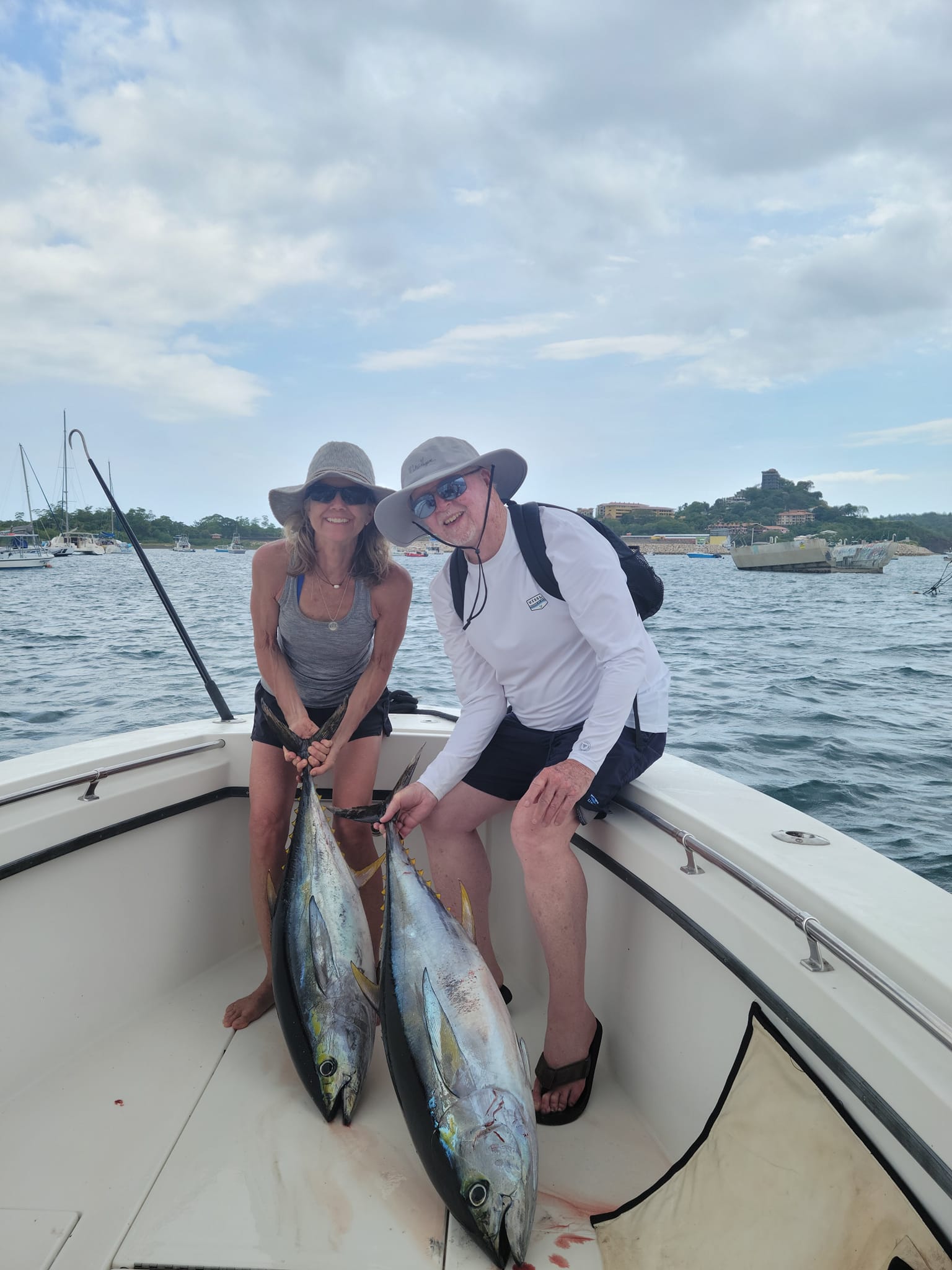
“Look!” Frank shouts. “Straight ahead, where the birds are!” Frank, our fishing boat captain, shoves the throttle to full ahead and we race toward what boat captains call la mancha—the stain—an area the size of a small arena where the deep blue ocean has been churned to a white froth. “Oh man, there are some big tuna breaking water, feeding on the surface.”

I can’t see the tuna but I definitely see the birds circling the area and diving into the water. And then the most amazing sight of all: spinner dolphins flying into the air, turning a half-dozen rotations before falling back to the water. Until this day, I’d never heard of a spinner dolphin, let alone seen one. And yet there they are—one, two, three, and more—shooting into the air like prima ballerinas.

We are twenty-five miles off the west coast of Costa Rica, out of the harbor town of Flamingo. Our party consists of my daughter Cheryl and her husband Bruce, their sons Mason and Collin, my daughter Kim, and me. Cheryl and her family have lived in Tamarindo for more than twenty years and are involved in several business ventures there. Kim lives in Welches, Oregon, with her husband Cliff and extended family. It’s my first visit to Costa Rica, a gift from my five children in honor of my eightieth birthday, and this will be a day I’ll never forget.

Bruce and my grandson Collin are experienced spear fishermen. Captain Frank will try to position the boat out in front of the dolphins and tuna. Then Bruce and Collin will jump into the water with snorkel gear and spear guns and descend about thirty feet below the surface. The dolphins will come racing by, followed closely by a school of yellowfin tuna. The goal is to get a good clean shot at a tuna, after which the speared fish will dive deep, taking with it a line attached to a float. The fish will eventually wear itself out, the float will come to the surface, and the catch hauled in.

We speed along with forty, fifty, a hundred or more dolphins racing alongside the boat. Bruce and Collin are in the bow, ready to go into the water. My grandson Mason is busy capturing as much of the action as possible via his 35 mm camera and his trusty smartphone. He is a skilled photographer, filmmaker and editor, like a young Spielberg. In the meantime, Captain Frank’s deckhand has rigged two fishing poles and cast them to troll behind the boat. Finally, Frank cuts the engine and Bruce and Collin are in the water, dropping below the surface, hoping for a clear shot as the tuna race by.

“Fish on!” Frank shouts. The rod nearest me bends at a ninety-degree angle and the reel sings as the line races out. “Grab that rod, Chuck. Let it run if it’s taking line, otherwise crank hard, reel it in.”

I go to the rod and begin reeling. The fish makes a couple of runs and I keep on cranking. My arm is tiring and I think about giving up, handing the job to someone else. But call it pride or call it machismo, there is no way I can quit. I keep straining to gain line. Suddenly the fish comes into view. I’m winning the battle. Now the deckhand moves in, a heavy glove on his left hand, a long gaff in his right. He grabs the line with his left hand and pulls the fish near the side of the boat. With his right, he makes a quick move with the gaff and jerks the fish up into the boat. It flaps wildly on the deck, blood splattering everywhere. In a matter of minutes, the deckhand has the yellowfin safely in cold storage, surrounded by bags of ice. Our best guess is it weighs about sixty pounds.

Bruce and Collin swim back to the boat disappointed. The drop point must be precise to find the tuna schooling behind the dolphins, and this time the positioning was off. Captain Frank idles as the spearfishermen climb aboard. All the while, the great gathering of fish and sea birds has moved on. The captain guns the engine and off we go, his eyes alternating between his radar screen and the horizon.

            Finding la mancha is a continuing challenge because the fish change direction frequently. We spend most of the day dashing here and there, trying to relocate our prey, successful on at least two more occasions. Late in the day the shout of “fish on” goes up again. This time Cheryl takes the rod and begins reeling. Aided by Collin, she lands our second yellowfin of the day. It’s a little smaller than the first one, but a beauty, nonetheless. Bruce and Collin come up empty, unable to find their prey today, but we have two nice tuna to bring home. 

It’s time to head back to shore and we begin the long journey home. I think about Cheryl and Bruce and the life they’ve built here in Costa Rica. Their entrepreneurial ventures are too numerous to list here, but the current flagship is their property management firm: Stay in Tamarindo. If you have an urge to visit Costa Rica, maybe catch a tuna of your own, or visit a volcanic national park, or catch a perfect wave on your surfboard, Stay in Tamarindo has the ideal vacation rental for you.

            The boat races on, the harbor coming into view. I think about Kim and the beautiful life she and hubby Cliff have built in Welches, Oregon. Kim provided a last-minute surprise, joining me in Los Angeles for the flight to Costa Rica. She will be with us for the first week of my stay and it is a joy to have Kim and Cheryl in one place at the same time. It doesn’t happen often enough. From these two beautiful daughters, I count seven of my twelve grandchildren, plus five great grandchildren, soon to be six.  

            What did I ever do to be so blessed?

***

Back home, Bruce goes to work immediately to clean and filet the fish. Collin and Mason jump in to make it a team effort. As Bruce carves off the filets, Collin trims and cuts them into thick steaks while Mason packs and seals them in freezer bags. Cheryl and Kim join the team, preparing rice, green salad, and other side dishes. My job is to hoist a cold beer and offer encouragement. Later that evening, we sit down to a dinner featuring perfectly seasoned and seared tuna steaks. It isn’t lost on me that these delicious steaks were swimming freely in the deep blue Pacific earlier this same day.

Through all of this teamwork, Mason has been telling us about a documentary series narrated by Sir David Attenborough titled Our Planet. One episode, “The High Seas,” features a segment on spinner dolphins. After dinner, we gather in front of the TV and Mason finds the episode we’re looking for. It is a fascinating explanation of what we witnessed at sea.

It turns out dolphins and yellowfin tuna feed on the same tiny species called lantern fish, a species that thrives because it has no commercial value and is, therefore, not hunted by the fishing fleets of the world. Yellowfin tuna follow the dolphins because dolphins are like cowboys, herding the lantern fish together into a compact school. The Attenborough team’s brilliant underwater photography captures this phenomenon perfectly, the dolphins working to keep the school together, the school of lantern fish looking like a giant balloon, swerving and swirling, held tight by the hard-working cowboys, all the while pushing the school toward the surface. Then, as though someone fired a starter’s pistol, the feast is on. Dolphins and tuna attack the lantern fish in a feeding frenzy, joined by sea birds diving from the air, creating the boil on the surface of the ocean the fishing captains call la mancha.

As for the spinner dolphins, according to Attenborough, they are very rare, found primarily in two locations: off the coast of Costa Rica and around the Hawaiian Islands. I am stunned! On a planet seventy percent covered by water, I spent the day in one of the two places on Earth that spinner dolphins call home.

When Sir David says goodnight, so does our intrepid crew. We’ve been up since four in the morning, a very long day indeed. Still, it takes a while for my mind to calm down and prepare for sleep. Every time I close my eyes, one, two, three, or more spinners go flying into the air, and Captain Frank is shouting, “Fish on!”


                                                  Me, Cheryl, Collin, Mason, Bruce, and Kim

_____